
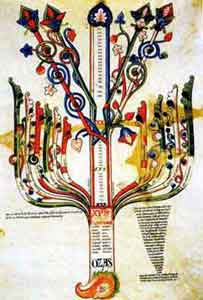
Joachim of Flora
Edmund G. Gardner - The Catholic Encyclopedia, Volume VIII
Copyright © 1910 by Robert Appleton Company
Cistercian abbot and mystic; b. at Celico, near Cosenza, Italy, c. 1132; d. at San Giovanni in Fiore, in Calabria, 30 March, 1202.
His father, Maurus de Celico (whose family name is said to have been Tabellione), a notary holding high office under the Norman kings of Sicily, placed him at an early in the royal Court. While on a pilgrimage to the Holy Land, Joachim was converted from the world by the sight of some great calamity (perhaps an outbreak of pestilence). He passed the whole of Lent in contemplation on Mount Thabor, where he is said to have received celestial illumination for the work of his life. Returning to Italy, he retired to the Cistercian Abbey of Sambucina, probably in 1159, and for some years devoted himself to lay preaching, without taking the religious habit or receiving any orders. The ecclesiastical authorities raising objections to his mode of life, he took the Cistercian habit in the Abbey of Corazzo, and was ordained priest, apparently in 1168. He now applied himself entirely to Biblical study, with a special view to the interpretation of the hidden meaning of the Scriptures.
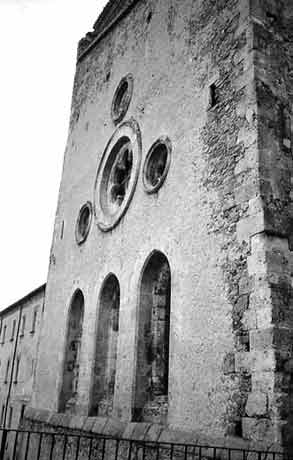
Florensian Abbey Apse; San Giovanni in Fiore
photography: Giuseppe De Marco © copyright 2003
Dante voiced the general opinion of his age in declaring Joachim one "endowed with prophetic spirit." But he himself always disclaimed the title of prophet. The interpretation of Scriptural prophecy, with reference to the history and the future of the Church, is the main theme of his three chief works: "Liber Concordiae Novi ac Veteris Testamenti," "Expositio in Apocalipsim," and "Psalterium Decem Cordarum." The mystical basis of his teaching is the doctrine of the "Eternal Gospel," founded on a strained interpretation of the text in the Apocalypse (xiv, 6). There are three states of the world, corresponding to the three Persons of the Blessed Trinity. In the first age the Father ruled, representing power and inspiring fear, to which the Old Testament dispensation corresponds; then the wisdom hidden through the ages was revealed in the Son, and we have the Catholic Church of the New Testament; a third period will come, the Kingdom of the Holy Spirit, a new dispensation of universal love, which will proceed from the Gospel of Christ, but transcend the letter of it, and in which there will be no need for disciplinary institutions. Joachim held that the second period was drawing to a close, and that the third epoch (already in part anticipated by St. Benedict) would actually begin after some great cataclysm which he tentatively calculated would befall in 1260. After this Latins and Greeks would be united in the new spiritual kingdom, freed alike from the fetters of the letter; the Jews would be converted, and the "Eternal Gospel" abide until the end of the world.
Although certain doctrines of Joachim concerning the Blessed Trinity were condemned by the Lateran Council in 1215, his main teaching does not seem to have excited suspicion until the middle of the century. Many works had meanwhile come into being which were wrongly attributed to Joachim. Among these the "De Oneribus Prophetarum," the "Expositio Sybillae et Merlini," and the commentaries on Jeremias and Isaias are the most famous. The sect of the "Joachists" or "Joachimists" arose among the "spiritual" party among the Franciscans, many of whom saw Antichrist already in the world in the person of Frederick II, nor was their faith shaken by his death in 1250. One of their number, Fra Gherardo of Borgo San Donnino, wrote a treatise entitled "Introductorium in Evangelium Aeternum", of which the contents are now known only from the extracts made by the commission of three cardinals who examined it in 1255. From these it is clear that the Joachists went far beyond what the abbot himself had taught. They held that, about the year 1200, the spirit of life had gone out of the two Testaments and that Joachim's three books themselves constituted this "Eternal Gospel," which was not simply to transcend but to supersede, the Gospel of Christ. The Catholic priesthood and the whole teaching of the New Testament was to be rendered void in a few years.
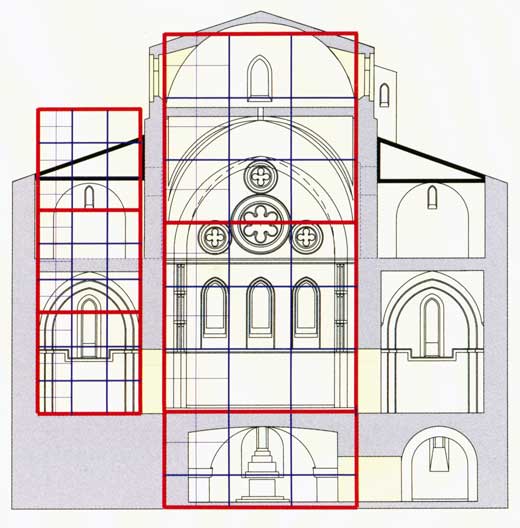
Florensian Abbey: Trasversal section: regulating principle, regulator tracing
ref: "La Chiesa Abbaziale Florense a San Giovanni in Fiore", Pasquale Lopetrone © copyright; Edizioni LIBRARE, San Giovanni in Fiore, 2002
This work was solemnly condemned by Alexander IV, in 1256, and the condemnation involved the teaching of Joachim himself. His central doctrine was confuted by St. Thomas in the Summa Theologica (I-II, Q. cvi, a. 4), and its Franciscan exponents were sternly repressed by St. Bonaventure. Another blow was given to the movement when the fatal year 1260 came, and nothing happened. "After Frederick II died who was Emperor," writes Fra Salimbene of Parma, "and the year 1260 passed, I entirely laid aside this doctrine, and I am disposed henceforth to believe nothing save what I see." It was revived in a modified form by the later leader of the spiritual Franciscans, Pier Giovanni Olivi (d. 1297), and his follower, Ubertino da Casale, who left the order in 1317. We hear a last echo of these theories in the letters of Blessed Giovanni dalle Celle and the prophecies of Telesphorus of Cosenza during the Great Schism, but they were no longer taken seriously.
Sources
Divini vatis Abbatis Joachim Liber Concordiae novi ac veteris Testatmenti (Venice, 1519); Expositio magni prophetae Abbatis Joachim in Apocalipsim: Eiusdem Psalterium Decem Cordarum opus prope divinum (Venice, 1527); REUTER, Geschichte der religiösen Aufklärung im Mittelalter, II (Berlin, 1877); TOCCO, L'Eresia nel Medio Evo (Florence, 1884); DENIFLE, Das Evangelium aeternum und die Commission zu Anagni in Archiv fur Litteratur- und Kirchen-Geschichte, I (Berlin, 1885): HOLDER-EGGER, Cronica Fratris Salimbene de Adam Ordinis Minorum (Hanover, 1905-08); WICKSTEED, The Everlasting Gospel in The Inquirer (London, 1909); FOURNIER, Etudes sur Joachim de Flore et ses doctrines (Paris, 1909). The only contemporary account is the sketch, Virtutum B. Joachimi synopsis, by LUCAS OF COSENZA, his secretary: but the fuller Vita by JACOBUS GRAECUS SYLLANAEUS, written in 1612, is professedly drawn from an ancient manuscript then preserved at Fiore. Both are printed by the Bollandists, Acta SS., May, VII.
EDMUND G. GARDNER
Transcribed by Alison S. Britton For the Triumph of the Immaculate Heart of Mary
The Catholic Encyclopedia, Volume VIII
Copyright © 1910 by Robert Appleton Company
Online Edition Copyright © 2003 by K. Knight
Nihil Obstat, October 1, 1910. Remy Lafort, S.T.D., Censor
Imprimatur. John Cardinal Farley, Archbishop of New York
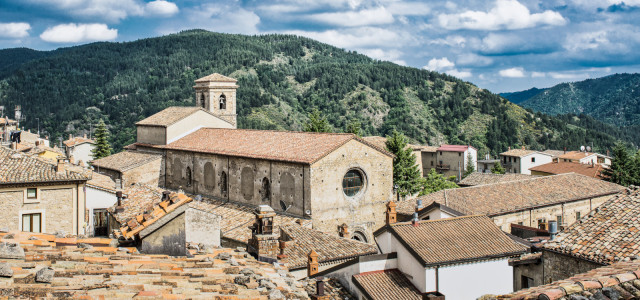
Florens Abbey; photograpy: Domenico Olivito
Links
This is a section of the site dedicated to the Mediterranean Architecture and that, going from the Mezquita de Cordoba to the Tiberius's Villa Iovis in Capri, from the Adalberto Libera's Villa Malaparte always in Capri until the Francesco Venezia's Gibellina Museum, from the Le Corbusier's Ronchamp Chapel to the Abbazia Florens of Gioacchino da Fiore and Luca Campano through the undergrounds of Naples, the underground architecture of the Greek Roman caverns exposed to the XVII Triennale of Milan, the ages, the cultural migrations, the Urbanism and Etno-Psychiatry, sometimes the losses, sometimes the contaminations, through various values and the religions, the aesthetic valences, with the contribution of personal written and of others Authors, of photography's, designs and other types of iconographic representations, 3d rendering, cad, videos, wants indicate a reflection course on this argument.